 how-to
Get Pre-Qualified for a Construction Loan: 2026 Guide
Table of Contents
- What Is a Construction Loan and How It Works
- Pre-Qualification vs. Pre-Approval for Construction Loans
- Construction Loan Documentation Checklist
- Eligibility Requirements and Credit Score Criteria
- Construction Loan Down Payment Requirements
- How Long Does Construction Loan Approval Take
- The Pre-Qualification Process: Step-by-Step
- Builder Vetting and Construction-to-Permanent Conversion
Last Updated: August 10, 2026
What Is a Construction Loan and How It Works
A construction loan is short-term financing that funds the building phase of a real estate project through completion. Unlike traditional mortgages that disburse funds upfront, construction loans release capital in stages called "draw schedules" as construction milestones are met, protecting both lender and borrower by tying disbursements to actual progress.
Construction loans operate on an interest-only payment structure during the building phase, you pay interest only on funds drawn, not the full loan amount. Once construction finishes, the loan converts into permanent financing, either a traditional mortgage or a construction-to-permanent loan that rolls directly into long-term debt.
A general contractor submits invoices and progress documentation. The lender's inspector verifies the work matches the construction phase outlined in blueprints. Only then does the next draw get released. For experienced real estate investors managing fix-and-flip projects or ground-up construction, Kala Group Capital specializes in fast construction financing, delivering credit decisions in 30 seconds and preliminary term sheets in under 5 minutes.
Pre-Qualification vs. Pre-Approval for Construction Loans
Pre-qualification and pre-approval are fundamentally different stages in the lending process, and conflating them costs borrowers time and credibility.
Pre-qualification is an informal assessment of your borrowing capacity based on information you provide. A lender reviews your income, debt, and credit profile and gives you a rough estimate of how much you might borrow. It requires minimal documentation and carries no weight in actual lending decisions.
Pre-approval is formal underwriting. The lender has verified your financial documentation, run a hard credit pull, and issued a binding letter stating your maximum loan amount, terms, and conditions. Pre-approval takes days or weeks because it involves real underwriting work. It's what sellers and contractors take seriously because it signals genuine lending capacity backed by verified data.
For construction loans, pre-qualification gets you in the door. Pre-approval moves you from prospect to funded borrower. Construction projects have tight timelines, and contractors need confidence that capital will actually close. A soft credit check during pre-qualification leaves your credit score untouched. Hard credit pulls during pre-approval may temporarily lower your score by a few points, but the impact is minimal if you're shopping multiple lenders within 14-45 days, as credit bureaus typically treat multiple inquiries as a single pull.
Construction Loan Documentation Checklist
Lenders require extensive financial documentation to underwrite construction loans. The more organized your submission, the faster the process moves.
Financial Documentation
- Last two years of personal and business tax returns (if self-employed or business owner)
- Most recent two months of personal and business bank statements
- Proof of income (pay stubs, 1099s, or K-1s)
- Asset verification (investment accounts, retirement accounts, real estate holdings)
- Debt list with current balances and monthly payments
Project Documentation
- Signed builder contract or purchase agreement
- Detailed construction budget and scope of work
- Blueprints and architectural specifications
- Timeline and construction schedule
- Proof of builder's license and insurance
- Property appraisal or preliminary valuation
Title and Legal Documentation
- Title report or preliminary title commitment
- Proof of property ownership or purchase agreement
- Zoning verification and building permits
- HOA documents (if applicable)
Credit and Identification
- Government-issued ID
- Social Security card or verification
- Authorization for credit check
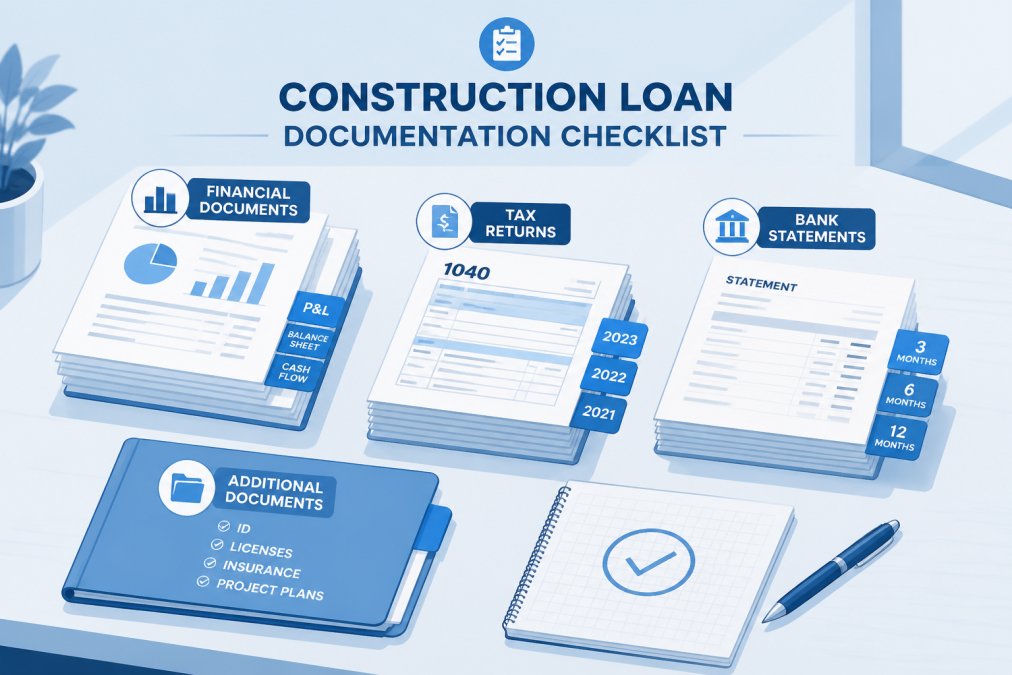
Organized documentation forces you to organize your financial picture before approaching lenders. Borrowers who arrive with complete, organized documentation close faster because underwriters spend less time chasing missing pieces. One common mistake is submitting incomplete or outdated documentation, bank statements must be current, tax returns must be filed and verifiable, and contractor licenses must be active. Incomplete packages force lenders to request revisions, adding days to your timeline.
Eligibility Requirements and Credit Score Criteria
Construction lenders evaluate eligibility across multiple dimensions beyond credit score alone. Your credit profile matters, but so does your real estate experience, project fundamentals, and financial stability.
Credit Score Requirements
Most construction lenders target borrowers with credit scores of 620 or higher, though scores above 680 unlock better terms and faster approval. A 620 score is technically acceptable but carries higher interest rates and more stringent documentation requirements. Scores below 620 become difficult; many lenders decline outright.
Construction lenders are more risk-averse than consumer lenders because they're funding illiquid assets, if a project stalls, the collateral is harder to liquidate than a completed home.
Debt-to-Income Ratio (DTI)
Lenders calculate your debt-to-income ratio by dividing total monthly debt payments by gross monthly income. Construction lenders typically require a DTI below 43 percent, though experienced investors with strong reserves may qualify up to 50 percent.
DTI measures your capacity to service debt. If you're already stretched thin paying existing mortgages and credit cards, adding construction loan payments becomes risky. Self-employed borrowers face scrutiny here, if your tax returns show inconsistent income, underwriters will average your income over two years rather than accepting current-year projections.
Experience and Track Record
Construction lenders increasingly factor in your real estate investment experience. First-time builders face stricter requirements than experienced investors with completed projects. If you've flipped five properties successfully, that history strengthens your application. If this is your first ground-up construction project, expect more scrutiny and potentially higher rates.
Financial Reserves
Lenders want to see cash reserves, liquid funds beyond the down payment that demonstrate financial stability. Reserves typically equal 6 to 12 months of your total monthly debt payments. A borrower with 100,000 dollars in liquid reserves and a 650 credit score often qualifies faster than someone with a 700 score but minimal reserves.
Construction Loan Down Payment Requirements
Construction loans require down payments of 15 to 25 percent, with experienced investors sometimes qualifying for 10 to 15 percent on strong projects. Down payment requirements reflect project risk, a fix-and-flip with a clear exit strategy may require 20 percent; ground-up construction in an untested market might require 25 percent.
Down payments for construction loans are typically held in reserve rather than paid upfront. You deposit funds into an escrow account, and the lender draws from that reserve to cover contingencies, cost overruns, or project delays. This protects both parties, you're not out the cash immediately, and the lender has collateral beyond the property itself.
Some lenders distinguish between "hard" down payments (cash you've accumulated) and "soft" down payments (equity in other properties). Hard down payments carry more weight because they're immediately accessible. Experienced investors often negotiate down payment requirements based on strong track records, substantial reserves, and well-vetted projects.
How Long Does Construction Loan Approval Take
Construction loan approval timelines depend on how organized you are, project complexity, and lender responsiveness.
The Pre-Qualification Phase (1-3 days)
Pre-qualification typically completes within 24 to 48 hours with complete financial information. Lenders run a soft credit check, verify income, and calculate borrowing capacity. Some lenders, including Kala Group Capital, deliver pre-qualification decisions in 30 seconds through automated systems. If underwriters flag issues, inconsistent income, recent late payments, or unclear debt, the process pauses while they investigate.
The Pre-Approval Phase (5-14 days)
Pre-approval is where real work happens. The lender orders a property appraisal (3-7 days), pulls a hard credit report, verifies employment and assets, and reviews the construction budget and project timeline. Pre-approval timelines compress significantly with complete documentation and straightforward projects. A fix-and-flip with clear scope, experienced contractor, and strong comparable sales can move through pre-approval in 5-7 days.
Full Underwriting (7-21 days)
Full underwriting begins once pre-approval is issued. The underwriter conditions the loan, requesting additional documentation, clarifications, or verification. Common conditions include updated bank statements, employment verification letters, or explanations of credit anomalies. Straightforward conditions can be satisfied in 2-3 days; unusual requests extend this phase.
Closing (3-7 days)
Once underwriting is clear and all conditions satisfied, the loan moves to closing. The lender prepares closing documents, title work finalizes, and you sign paperwork. Funding typically occurs within 3-7 days of closing.
Total timeline from application to funding: 15 to 45 days in most cases. Experienced borrowers with complete documentation, strong financials, and straightforward projects close in 15-21 days. Complex projects, first-time borrowers, or incomplete documentation can extend to 45 days or longer. Timeline pressure is real in construction, a 30-day delay costs money as contractors move to other projects and material prices fluctuate.
The Pre-Qualification Process: Step-by-Step
Getting pre-qualified for a construction loan is straightforward if you approach it systematically.
Step 1: Gather Your Financial Information (Time: 1-2 hours)
Collect core financial documents: last two years of tax returns, most recent two months of bank statements, employment verification or business income documentation, and a list of current debts with balances and monthly payments. Having this information organized before contacting a lender dramatically speeds the process.
Step 2: Identify Your Project and Gather Project Details (Time: 1-3 hours)
Know what you're financing. Is this a fix-and-flip, ground-up construction, or multi-family development? Have a preliminary estimate of the project budget, construction timeline, and expected completion date. If you have a builder or general contractor lined up, gather their license information and contact details.
Step 3: Submit Your Pre-Qualification Application (Time: 15-30 minutes)
Most lenders offer online applications that take 15-30 minutes to complete. You'll enter personal information, employment details, financial information, and project details. The application asks for permission to pull a soft credit check, which won't impact your credit score. Submit with complete, accurate information, incomplete applications get flagged and require follow-up.
Step 4: Receive Your Pre-Qualification Decision (Time: 24-48 hours, sometimes instant)
The lender's system processes your application and generates a pre-qualification decision, including your estimated borrowing capacity, general terms, and next steps. Some lenders, like Kala Group Capital, deliver this decision instantly through automated underwriting. Your pre-qualification decision is an estimate based on information provided, the lender hasn't verified documentation, run a hard credit check, or appraised the property.
Step 5: Move to Pre-Approval (Optional but Recommended)
If you're serious about the project, request pre-approval. This requires submitting full documentation, tax returns, bank statements, employment verification, and project details. The lender orders an appraisal, pulls a hard credit report, and begins formal underwriting. Pre-approval takes 5-14 days depending on documentation completeness and project complexity. At the end, you receive a pre-approval letter stating your maximum loan amount and terms.

Builder Vetting and Construction-to-Permanent Conversion
Choosing the right general contractor is as important as securing financing. Lenders evaluate contractors because contractor competence directly impacts project success and collateral quality.
What Lenders Look For in Contractors
Lenders verify that your general contractor has an active license, appropriate insurance coverage, and a clean disciplinary history. They pull contractor license records from your state's licensing board and verify that no complaints or violations are on file.
Lenders want evidence of successful project history. Have they completed similar projects? Can they provide references from previous clients? Contractors with established track records move projects faster and with fewer cost overruns, reducing lender risk. A common mistake is hiring the lowest-bid contractor, inexperienced or undercapitalized contractors often underestimate costs, leading to project delays and budget overruns.
Construction-to-Permanent Loan Conversion
A construction-to-permanent loan combines construction financing and permanent mortgage financing into a single loan product. During construction, you pay interest-only on the drawn balance. Upon completion, the loan automatically converts to a traditional amortizing mortgage.
The advantage is simplicity, one closing, one set of fees, one lender relationship. You avoid refinancing from a construction loan into a permanent mortgage after project completion. The permanent rate is locked in at origination, protecting you from rate increases if market conditions shift during construction.
The disadvantage is that construction-to-permanent loans typically carry slightly higher rates than separate construction loans. You're also committing to a specific permanent loan amount and term before construction is complete. For ground-up construction and fix-and-flips destined for long-term hold or rental, construction-to-permanent loans make sense. For fix-and-flips intended for quick sale, traditional construction loans followed by buyer financing are often more flexible.
Self-Build and Owner-Builder Financing
Owner-builder financing (where you act as your own general contractor) is more restrictive in the lending market. Most institutional lenders avoid owner-builder deals because they require the borrower to manage complex construction processes while simultaneously managing financing, permits, and inspections.
Some lenders specialize in owner-builder financing, but terms are typically less favorable, higher rates, larger down payments, more stringent documentation. If you're considering owner-builder financing, expect to provide extensive evidence of construction experience and detailed project plans. Some lenders require owner-builders to hire a licensed construction manager to oversee the project.
Getting pre-qualified for a construction loan is the foundation of moving from deal analysis to funded capital. The process is straightforward if you understand the stages, gather your documentation, and work with a lender that prioritizes speed without sacrificing underwriting rigor. Kala Group Capital's 30-second credit decisions and 5-minute term sheets compress timelines dramatically when your fundamentals are solid and documentation is complete.
The real difference between lenders isn't speed alone; it's speed backed by actual lending capacity. When you apply with organized financials, a clear project, and a vetted contractor, the fastest lenders deliver the best terms because they're confident in your ability to close and perform. Start with pre-qualification to establish your borrowing range, then move to pre-approval when you're ready to commit. From there, full underwriting and closing follow the documented path.
Frequently Asked Questions
Can you get pre-qualified for a construction loan online?
Yes. Most modern lenders, including those specializing in construction financing, offer online pre-qualification. You provide basic financial and project information through an easy platform. Many lenders deliver credit decisions within minutes, not days. Online pre-qualification typically involves a soft credit check, which does not impact your credit score. This allows you to understand your borrowing capacity and loan terms before committing to a full application.
What credit score do I need to get pre-qualified for a construction loan?
Most construction lenders require a minimum credit score between 620 and 680, though competitive rates typically require 700 or higher. Your credit score is one factor among many, lenders also evaluate debt-to-income ratio, liquid assets, and project details. If your score is below the minimum, some lenders will still work with you but may offer less favorable terms. Self-employed investors and builders often find that asset verification and proof of income matter as much as credit history.
What documents do I need for construction loan pre-qualification?
For pre-qualification, have ready: recent tax returns (typically 2 years), bank and asset statements, proof of income, a project budget or builder contract, and property details. Full pre-approval requires more, appraisals, detailed construction plans, contractor credentials, and proof of down payment funds. Pre-qualification is faster because it uses a soft credit check and preliminary financial review. Full approval involves underwriting, a hard credit pull, and appraisal, which takes longer but locks in your terms.
How long does it take to get pre-qualified and fully approved for a construction loan?
Pre-qualification can happen in minutes to hours, some lenders deliver decisions in 30 seconds. Full approval typically takes 5 to 21 days, depending on documentation completeness, appraisal timing, and underwriting complexity. The construction-to-permanent loan conversion adds another phase once construction begins. Timelines depend on your responsiveness with documents, the lender's workload, and whether your project or financial profile requires additional review. Providing all documentation upfront dramatically accelerates approval.
This article was written using GrandRanker