 ultimate-guide
Real Estate Loan Closing Timeline: What to Expect
Table of Contents
- What to Expect: Real Estate Loan Closing Timeline Overview
- The Closing Process: Step-by-Step Breakdown
- Mortgage Underwriting Timeline: A Critical Phase
- Factors That Delay Home Closing: What Actually Slows You Down
- Understanding the Closing Disclosure Timeline
- Accelerating Your Closing: Practical Steps to Speed Up Funding
- Digital vs. Traditional Closing: Speed and Flexibility Differences
- Post-Closing Checklist: What Happens After Funding
What to Expect: Real Estate Loan Closing Timeline Overview
Understanding real estate loan closing timeline expectations is essential for anyone financing a property purchase. At Kala Group Capital, we work with investors and builders who need to move quickly, and the closing timeline is often the critical variable between a deal that works and one that doesn't. For financed closings, you're typically looking at 30-45 days from application to funding, though experienced investors often see much faster timelines with the right lender and preparation.
The closing process is a series of interconnected phases that begin when you submit your mortgage application and conclude when the deed is recorded and funds are disbursed.
Typical timeline phases for financed closings
Phase 1: Application and Pre-Approval (3-5 days). You submit your mortgage application with financial documentation and receive a preliminary credit decision. According to Federal Reserve guidance on mortgage lending, lenders must provide a Loan Estimate within three business days of receiving your application. Incomplete applications extend this phase significantly.
Phase 2: Home Inspection, Appraisal, and Title Search (7-14 days). These processes run in parallel. The home inspection typically completes in 1-2 days. The appraisal takes 5-10 days from order to completion. The title search usually finishes within 3-5 business days. Appraisal issues or title problems can push everything backward.
Phase 3: Loan Processing and Underwriting (10-20 days). Your loan officer verifies employment and income while underwriting reviews your application against the lender's guidelines. This phase is the longest and most variable. Some loans clear in 5 days; others sit in underwriting for 20+ days if there are questions about income documentation, credit events, or property condition.
Phase 4: Clear to Close and Final Walkthrough (1-3 days). Once underwriting approves your loan, you receive a Closing Disclosure showing all loan terms and closing costs. Federal regulations require a three-day waiting period before closing. You conduct a final walkthrough to verify property condition and that agreed-upon repairs are complete.
Phase 5: Closing Day and Funding (1 day). You sign closing documents, the title company records the deed, and the lender funds the loan. Funding typically occurs the same day as signing or the following business day.
How cash closings differ from financed transactions
Cash closings compress the timeline to 7-14 days from offer acceptance to funding because they eliminate underwriting, appraisal, and mortgage processing. You still need a title search and title insurance, but the lender-driven timeline disappears. There is no three-day Closing Disclosure waiting period (a federal requirement for financed loans only). This speed is why cash offers are attractive in competitive markets.
The Closing Process: Step-by-Step Breakdown
Step 1: Mortgage application and pre-approval
You submit your mortgage application with personal information, employment history, income documentation (tax returns, W-2s, pay stubs), bank statements, and property details. The lender orders a credit report and runs an initial underwriting review. Within 24-48 hours, you receive a preliminary decision. Within three business days, the lender must provide a Loan Estimate detailing your loan terms, interest rate, and estimated closing costs.
This step moves quickly if your documentation is complete and your credit is clean. Self-employed borrowers or those with recent income changes should expect additional documentation requests, which add 2-3 days per request.

Step 2: Home inspection, appraisal, and title search
Once your application is submitted, the loan officer orders the appraisal and title search. You schedule the home inspection independently. The home inspection typically happens within 3-5 days of scheduling and takes 2-3 hours. If significant issues are discovered, renegotiation can delay the timeline by 5-10 days.
The appraisal is assigned to a licensed appraiser who typically has 5-7 days to complete it. If the appraisal comes in below the purchase price, the lender may require a larger down payment or the deal may need renegotiation, adding 7-14 days.
The title search runs concurrently and usually completes within 3-5 business days. If title issues are discovered (liens, unpaid taxes, boundary disputes), resolution can take 1-3 weeks.
Step 3: Loan processing and underwriting
Loan processing is the administrative phase where your loan officer verifies documentation and coordinates with underwriting. Underwriting typically takes 5-15 business days. The underwriter reviews the appraisal, title report, and your financial documentation, then either issues "clear to close" or requests additional items (underwriting conditions).
If the underwriter issues conditions, you have 2-5 days to provide the requested documents. Once you submit them, the underwriter reviews again in 2-3 days. This is where most delays occur. Incomplete initial documentation, appraisal issues, or title problems all extend this timeline.
Step 4: Clear to close and final walkthrough
Once you receive "clear to close," the lender prepares your closing documents and the title company prepares the settlement statement. Federal law requires a three-day waiting period between receiving the Closing Disclosure and closing. This period cannot be waived.
During this waiting period, you review the Closing Disclosure carefully and conduct a final walkthrough of the property to confirm repairs are complete and the property is in expected condition.
Step 5: Closing day and deed transfer
On closing day, you meet with the title company and sign the promissory note, mortgage or deed of trust, and other documents. The title company records the deed with the county recorder's office. Recording typically happens the same day or the following business day. The lender simultaneously funds the loan, and the title company disburses funds to the seller, real estate agents, and other parties.
Mortgage Underwriting Timeline: A Critical Phase
Underwriting is where most real estate loan closing timeline expectations either get met or derailed. This is where the lender's underwriter reviews your entire financial picture and property details against the lender's risk guidelines.
How underwriting conditions affect your timeline
If everything aligns with the lender's guidelines, you get "clear to close" quickly, sometimes within 5 business days. However, if the underwriter has questions, they issue underwriting conditions. Common conditions include:
- Verification of Employment (VOE): The underwriter contacts your employer to confirm employment (1-3 business days).
- Updated bank statements: If your bank statements are older than 60 days, the underwriter requests current statements to verify your down payment funds.
- Explanation letters: If you have late payments, collections accounts, or recent credit inquiries, the underwriter requests a written explanation.
- Proof of debt payoff: If you promised to pay off a credit card or loan before closing, the underwriter requests proof.
- Additional income documentation: If you're self-employed or have recent income changes, the underwriter may request additional tax returns or accountant letters.
Each condition adds 2-5 days to your timeline. A loan with three conditions might take 20-25 days to clear, while a clean loan clears in 8-10 days.
What happens between loan estimate and clear to close
From receiving your Loan Estimate to receiving "clear to close" (typically 15-30 days later), the appraisal is ordered and completed, the title search is conducted, your financial documentation is verified, underwriting review occurs, and any conditions are satisfied. The timeline from Loan Estimate to "clear to close" is typically 15-25 days for straightforward applications, 25-35 days if there are minor conditions, and 35+ days if there are significant complications.
Factors That Delay Home Closing: What Actually Slows You Down
Documentation gaps and missing paperwork
The single most common cause of closing delays is incomplete or missing documentation. Common gaps include incomplete employment history, missing bank statements, undisclosed debts, and unclear income documentation. Provide complete, accurate documentation upfront: have your tax returns, W-2s, pay stubs, bank statements, and employment verification ready before you apply.
Appraisal issues and property survey complications
An appraisal that comes in below the purchase price can derail a deal or force renegotiation, adding 5-15 days. Property survey issues are less common but equally disruptive. If the survey reveals boundary disputes or encroachments, resolution can take weeks.
Title problems and contingency failures
Title problems (liens, judgments, unpaid taxes, boundary disputes) can prevent closing until resolved. If contingencies fail (home inspection reveals major issues, appraisal comes in low), the deal stalls while renegotiation occurs.
Lender volume and underwriting backlogs
During busy seasons, lenders experience high application volume and underwriting backlogs can extend timelines by 5-10 days. You can mitigate this by applying early in the week and choosing a lender that manages volume strategically. At Kala Group Capital, we deliver credit decisions in 30 seconds and preliminary term sheets in under 5 minutes, so you're not sitting in a queue waiting for initial review.
Understanding the Closing Disclosure Timeline
When you receive the closing disclosure and settlement statement
Once your loan is "clear to close," the lender prepares your Closing Disclosure. By federal law, you must receive this document at least three business days before closing. The settlement statement itemizes all funds received and disbursed at closing, typically prepared by the title company the day before or morning of closing.
The three-day review requirement
The three-day waiting period between receiving the Closing Disclosure and closing is federally mandated and cannot be waived. If you receive the Closing Disclosure on Monday, the earliest you can close is Thursday. Use this time to carefully review your interest rate, loan amount, monthly payment, property taxes and insurance estimates, all closing costs, and the total amount you're bringing to closing. If you find errors, contact your loan officer immediately.
Accelerating Your Closing: Practical Steps to Speed Up Funding
Prepare documentation early and completely
The biggest lever for speeding up closing is providing complete, accurate documentation upfront. Before you apply, gather last two years of tax returns, last two months of pay stubs, last two months of bank statements, employment verification letters, list of all debts, explanation letters for any credit events, and proof of down payment source. Lenders receiving complete applications upfront typically clear loans 5-10 days faster.
Work with a responsive loan officer and real estate agent
Your loan officer is your advocate during closing. A responsive loan officer follows up on appraisals, coordinates with underwriting, and proactively addresses issues. Your real estate agent coordinates inspections, communicates with the seller about repairs, and ensures deadlines are met.
Lock your interest rate promptly
Interest rate locks protect you from rate increases while your loan is processed. Rate locks have expiration dates, typically 30, 45, or 60 days. Lock your rate as soon as your application is submitted to give yourself the longest runway to close before the lock expires.
Coordinate inspections, appraisals, and surveys efficiently
Schedule your home inspection immediately after your offer is accepted. Don't wait for the lender to order the appraisal. If a property survey is needed, order it early since surveys can take 5-10 days.
Digital vs. Traditional Closing: Speed and Flexibility Differences
How digital closings compress timelines
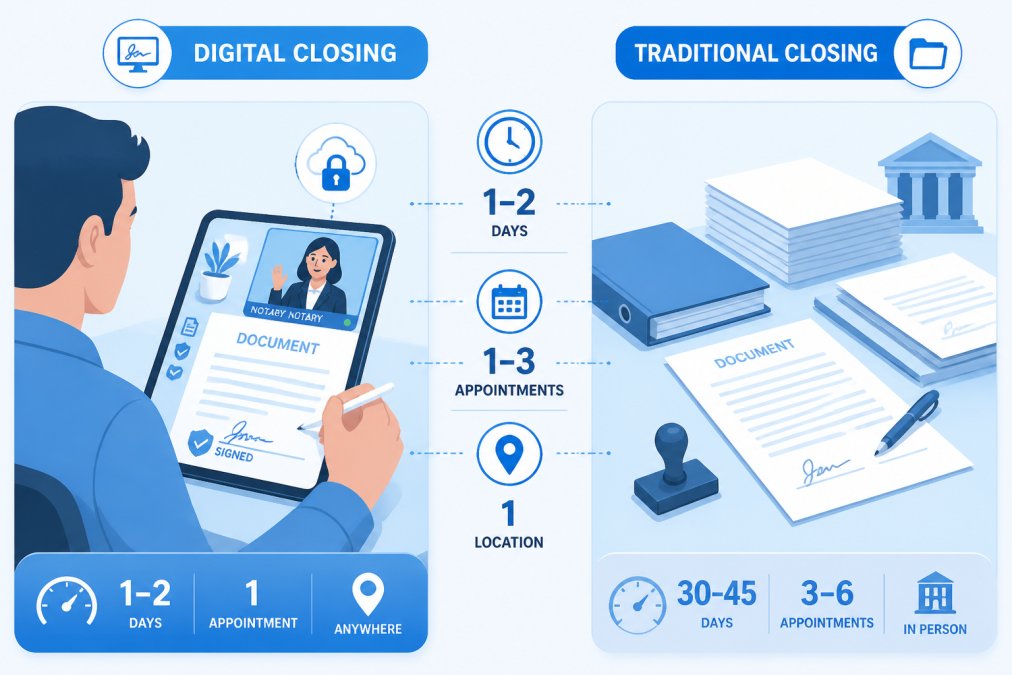
A digital closing uses electronic signature technology to allow you to sign closing documents remotely. A notary public witnesses your signatures remotely via video call. Digital closings eliminate travel time and can happen outside traditional business hours, compressing the timeline by 1-2 days. However, the core timeline (underwriting, appraisal, title work) remains the same.
Notary public requirements and e-signature protocols
For a digital closing to be legally valid, a notary public must witness your signatures and verify your identity via video call. The notary verifies your identity using government-issued ID and maintains a record of the transaction. Different states have different requirements for digital closings, so verify that your state allows electronic notarization before choosing a digital closing.
Post-Closing Checklist: What Happens After Funding
Verifying fund disbursement and loan funding completion
On closing day, the lender funds the loan and the title company disburses funds to the seller, real estate agents, and other parties. You should receive confirmation from the title company within 24 hours. Verify that the lender has funded the loan, the title company has received the funds, the seller has received payment, all closing costs have been paid from closing proceeds, and you've received a final accounting.
Recording the deed and obtaining homeowners insurance confirmation
The title company records the deed with the county recorder's office. Recording typically happens the same day as closing or within 1-2 business days. You should receive a recorded deed copy within 5-10 business days. Homeowners insurance is typically required by the lender before closing. After closing, verify that your insurance policy is active and that the lender is listed as an interested party.
Frequently Asked Questions
What is the average real estate loan closing timeline?
Most financed closings take 30-45 days from mortgage application to funding. The timeline depends on loan type, documentation completeness, and property complexity. Cash closings typically close in 7-14 days. For experienced investors with pre-approval and complete documentation, some lenders can close in as few as 3-5 days, though this requires all parties moving in sync.
How long does mortgage underwriting timeline typically take?
Mortgage underwriting typically takes 3-7 business days after your loan application is submitted. During this phase, the underwriter reviews your financial documents, verifies employment, orders the appraisal, and conducts the title search. Underwriting conditions may extend this timeline if documentation gaps appear. Once you provide all requested items and clear to close is issued, closing can occur within 2-5 business days.
What factors that delay home closing should I watch for?
Common delays include incomplete documentation, low appraisals, title issues, failed contingencies, and lender backlogs. Missing tax returns, employment verification problems, or survey complications can add 5-10 days. Property defects discovered during inspection or appraisal may require renegotiation. Coordinating multiple parties (escrow officer, loan officer, real estate agent, notary public) efficiently prevents unnecessary delays.
When do I receive the closing disclosure and what is the timeline?
You receive the closing disclosure at least three business days before closing. This document shows final loan terms, closing costs, and settlement statement details. Federal law requires this three-day waiting period so you can review all terms before signing. The closing disclosure timeline is non-negotiable, so plan your closing day accordingly. Digital closings may allow you to review documents electronically during this period.
Can I close faster with a cash offer versus a financed loan?
Yes, significantly faster. Cash closings typically complete in 7-14 days because they skip mortgage underwriting, appraisal, and loan processing. You avoid the mortgage application, loan estimate, and underwriting conditions phases. However, you still need a title search, property survey if required, and deed transfer. The three-day closing disclosure requirement doesn't apply to cash transactions, removing another delay.
What happens on closing day and how long does it take?
On closing day, you sign final documents with a notary public, verify fund disbursement, and transfer the deed. The actual signing typically takes 1-2 hours. The escrow officer coordinates funding between your lender and the seller's account. After all parties sign and funds clear, the deed is recorded with the county. You receive the keys once recording is confirmed, which may occur same-day or next business day depending on county processing speed.
How does digital closing affect the real estate loan closing timeline?
Digital closings can compress timelines by 2-5 days by eliminating in-person meeting requirements. You sign documents electronically using e-signature and a remote notary public via video. This works especially well for investors managing multiple projects simultaneously. However, the three-day closing disclosure waiting period still applies. Digital closings require reliable internet, proper ID verification, and coordination with an escrow officer familiar with remote procedures.
This article was written using GrandRanker